top of page

The common ostrich Struthio camelus is the largest living bird: a male ostrich can reach a height of 9.2 feet (2.8 meters) and weigh over 344 pounds (156 kilos) [1]. Ostriches are flightless. In the 18th century, ostrich feathers were so popular in ladies’ fashion that they disappeared from all of North Africa. If not for ostrich farming, which began in 1838, then the world’s largest bird would probably be extinct [2]!


Today, we share a chromosome-length genome assembly for the common ostrich. This is an upgrade from a draft generated by the Avian Genome Consortium, see (Zhang, Li et al., Science, 2014) and accompanying papers for more details. We thank the Oklahoma City Zoo for providing us with a sample used for Hi-C library preparation!


Birds are divided into two clades, the paleognaths and the neognaths. The paleognaths are a much smaller clade, and with the exception of the tinamou, they are flightless. With today’s upgrade to ostrich, we’ve now released chromosome-length assemblies of most of the paleognath genera (the ostrich, the emu, the cassowary and greater rhea). To complete the collection, we’re still looking for samples of tinamou and kiwi - if you have a sample, even a pretty low-quality sample, it could make a big difference. Please consider sending it along!


Below is a whole-genome alignment plot comparing the ostrich chromosomes to those of the other paleognaths in our collection: the emu, the cassowary and greater rhea (all DNA Zoo upgrades from Sackton et al., Science, 2019). Also included is the alignment to the chicken chromosomes, from the International Chicken Genome Sequencing Consortium.

ree
Whole-genome alignments between the new chromosome-length assembly for the common ostrich (ASM69896v1_HiC) and the genome assemblies of the emu, cassowary and greater rhea (droNov1_HiC, casCas1_HiC and rheAme1_HiC, respectively, all DNA Zoo upgrades of genomes from Sackton et al., Science, 2019), as well as chicken (GRCg6a, from the International Chicken Genome Sequencing Consortium).

Because the original draft and the Hi-C signal have been generated using samples from female birds, both Z and W chromosomes are represented in the DNA Zoo assembly. The structure of the ostrich Z was recently explored in (Yazdi and Ellegren, Genome Biol Evol, 2018). There, they generated a genetic map for the ostrich Z chromosome (chr# 6 in the new genome assembly), building on 2015 improvements using optical mapping data from (Zhang et al., GigaScience, 2015).


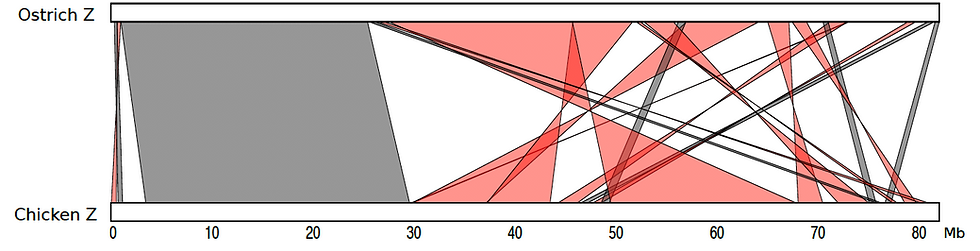
It is worth noting that while we have not used the optical and genetic mapping data for our assembly, our conclusions on the syntenic relationship between the ostrich Z and the chicken Z, shown above, broadly agree with those suggested by the published genetic map (see figure below). These suggest a large ~30Mb collinear region near the p-end of the sex chromosome. The highly rearranged portion towards the q-end (~50Mb) corresponds to the pseudoautosomal region (where recombination is possible between the Z and the W chromosomes).
ree
Fig. S2 from Yazdi and Ellegren, Genome Biol Evol, 2018: The grouping of genes into synteny blocks between the ostrich and chicken Z chromosome. Grey: genes with conserved gene orientation between the two species. Red: inverted genes in one species compared to the other.


Gerenuk (Litocranius walleri) is an exceptionally long-necked antelope from East Africa. They feed at higher reaches than most other gazelles and antelopes: standing on their hind legs they can reach as high as eight feet off the ground [1]!


Due to habitat loss and fragmentation today the gerenuks are classified as near threatened [2]. Populations have declined by 25 percent over the last 14 years, and it is now estimated that gerenuk is close to meeting the threshold for being uplisted to vulnerable [1].


Today, we share the chromosome-length assembly for the gerenuk. This is another upgrade from a recent Science paper by Chen, Qiu, Juiang, Wang, Lin, Li et al. We are grateful to Houston Zoo for donating a sample that was used for in situ Hi-C library preparation needed for the upgrade!


This is the third member of the Bovidae family in our collection. The Bovidae are the most diverse group of living ungulates that includes many agriculturally important animals such as cattle, goat and sheep. See below how the genome assemblies of the three genomes (the bison Bison bison, the sable antelope Hippotragus niger and the gerenuk Litocranius walleri, all corresponding to 2n=60 karyotype) align to the genome of the cow, from (Zimin et al., Genome Biol. 2009). Just as noted in our last post on ruminant genomes, complex rearrangements are observed on the sex chromosome (aligning to chr#30 in the cow). Stay tuned for more ruminant genome assemblies!

ree
Whole-genome alignments between the three DNA Zoo genome assemblies from the Bovidae family, bison (Bison_UMD1.0_HiC), sable antelope (Sable_antelope_masurca.scf_HiC) and gerenuk (GRK_HiC), to the cattle genome assembly (Bos_taurus_UMD_3.1.1). Note that the bison genome assembly used for this analysis is updated as compared to the one originally released.


Reeves’s muntjac also known as Chinese muntjac (Muntiacus reevesi) is a deer species found widely in southeastern China and Taiwan. It has been introduced in Belgium, the Netherlands, the UK, Ireland and Japan, and proved invasive outside its native range [1].


Today, we are sharing a chromosome-length genome assembly for the Reeves’s muntjac. This is an upgrade from a recent paper in Science by Chen, Qiu, Juiang, Wang, Lin, Li et al. We thank SeaWorld for helping us with the sample used to generate Hi-C data for the upgrade!


See below our usual analysis of the karyotype of the new chromosome-length genome assembly for the Reeves’s muntjac (2n=46) against that of a cow (2n=60), from (Zimin et al., Genome Biol. 2009). Rearrangements outside of centric and tandem fusions seem rare. A notable exception is the sex chromosome (#5 in the Reeves’s muntjac, #30 in cattle) where the rearrangement picture is more complex.

ree
Whole-genome alignment between the new chromosome-length genome assembly for the Reeves’s muntjac (CIJ_HiC) and that of cattle (Bos_taurus_UMD_3.1.1).

Excitingly, this is one of the rare occurrences where chromosome painting data is available from previous research. The data allows for independent validation of the karyotype predicted by the assembly. See Fig. 4 (copied below) from (Frohlich et al., PLoS ONE, 2017) that shows hybridization patterns of appropriate cattle painting probes for 6 Reeves’s muntjac’s chromosomes: MRE1=chr#1, MRE2=chr#2, MRE3=chr#3, MRE4=chr#4, MRE5=chr#6, MRE11=chr#10. While the chromosome painting data was not used during the generation of the assembly, they are in perfect agreement!

ree
Frohlich et al., PLoS ONE, 2017; Fig. 4: Rearrangements on Chinese muntjac chromosomes MRE1–5 and 11 are demonstrated by hybridization patterns of appropriate cattle painting probes (on the right). MRE1 corresponds to chr#1 in the new assembly, MRE2 to chr#2, MRE3 to chr#3, MRE4 to chr#4, MRE5 to chr#6 and MRE11 to chr#10.


Join our mailing list

ARC-Logo-Final-2018-01.png

© 2018-2022 by the Aiden Lab.

bottom of page